
Improving compressive strength and CBR with nanotechnology for unpaved roads
Effective and sustainable soil stabilization is today one of the most relevant challenges in road construction and light infrastructure. The quality of the subgrade and its bearing capacity determine the durability and safety of unpaved roads, cycle paths, pedestrian areas, and parking lots.
Thanks to new polymer-based nanotechnologies, it is possible to achieve significant improvements in compressive strength and in the California Bearing Ratio (CBR), while minimizing the use of high-impact materials such as cement and lime.
Laboratory test results
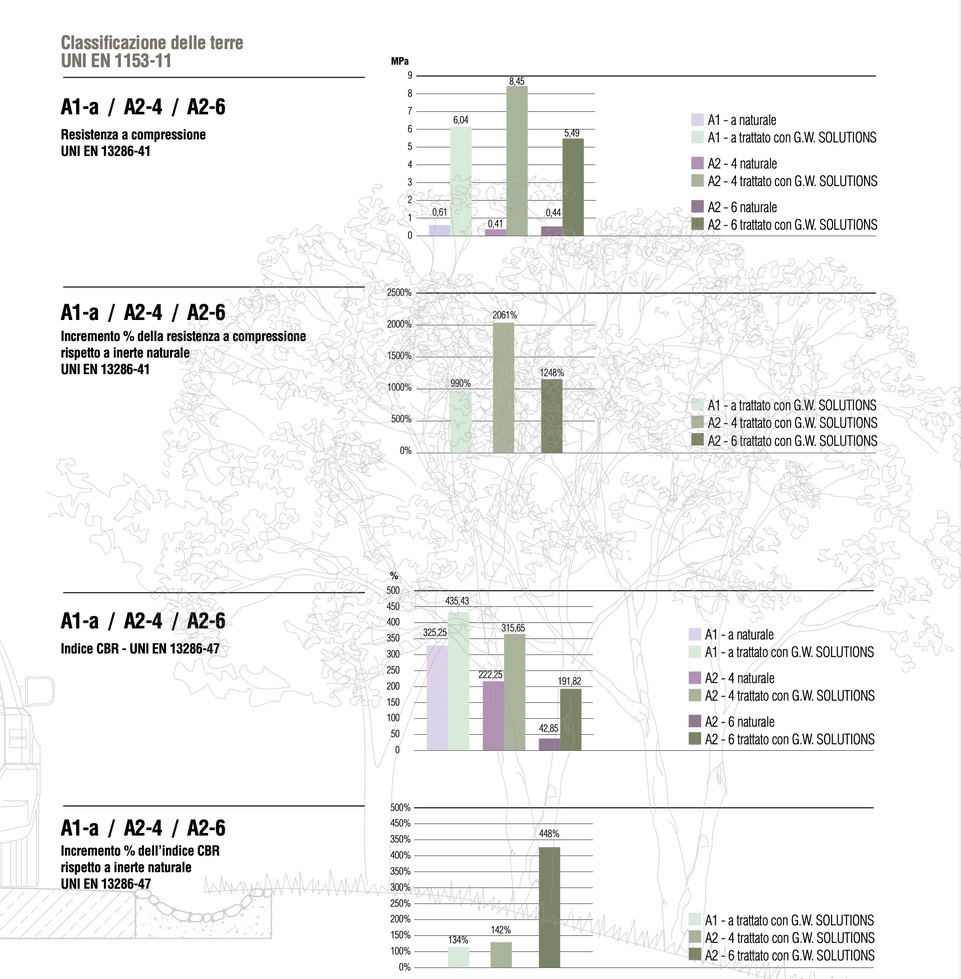
Laboratory tests carried out on soils of different classifications (A1a, A2-4, A2-6) show that applying a calibrated dosage of polymeric binder allows:
- a significant increase in Unconfined Compressive Strength (UCS);
- a marked increase in CBR, the key parameter for evaluating the bearing capacity of a road subgrade.
In some cases, values increased from 0.41 MPa to over 8.45 MPa.
A 2060% increase goes far beyond the requirements of light infrastructures, such as a simple cycle path: it is an extraordinary performance, crucial for infrastructures subjected to heavy vehicular traffic.
Optimizing binder dosage is therefore a key step: it ensures that the required performance is met while avoiding material waste.
On-site plate load test
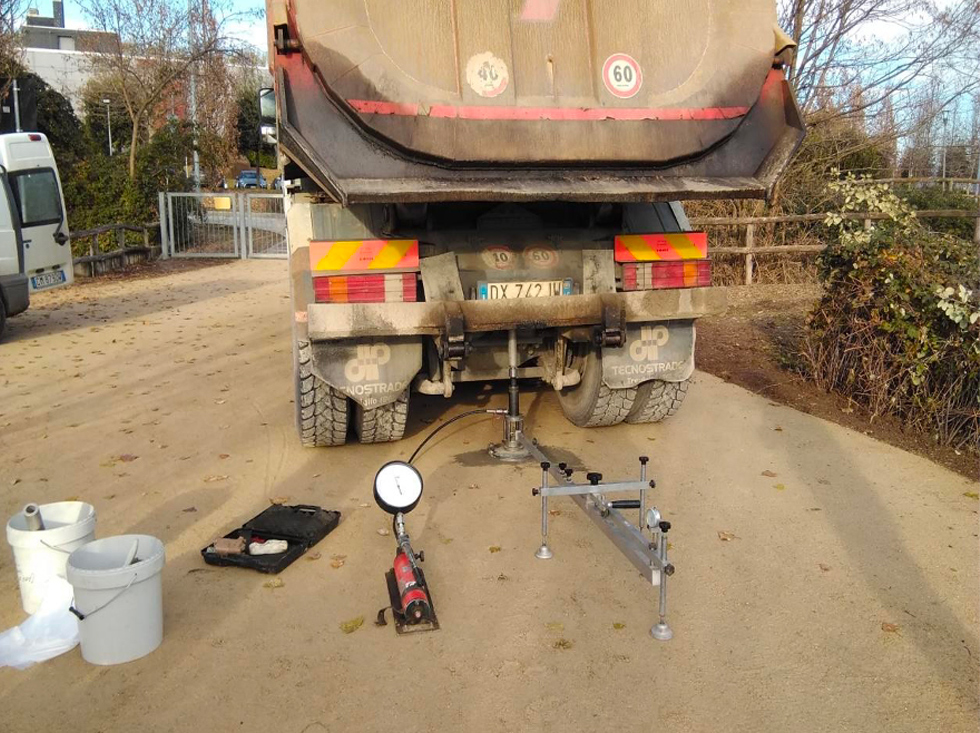
The laboratory results were confirmed by direct field tests. One example is the plate load test (CNR 146/1992 standard) performed at the Parco della Trucca construction site in Bergamo.
The test, which measures subgrade bearing capacity and compaction, provided deformation and modulus values (Md and M’d) fully compliant with the required standards. This demonstrates how nanotechnology-based polymer binders can effectively replace cement in soil stabilization processes for unpaved roads and urban areas.
Benefits for designers and contractors
Adopting Green Ways® nanotechnology-based solutions provides both economic and environmental benefits:
- Economic benefits: optimized dosages reduce procurement and transport costs, avoiding unnecessary excesses;
- Environmental benefits: elimination of hundreds of kilograms of cement per cubic meter of treated soil, reduced aggregate hauling, lower heavy traffic, and reduced CO₂ emissions.
A tailored technology for unpaved roads
Each soil stabilization intervention must be designed according to:
- soil type (grain size analysis and classification according to UNI 11531-1, USCS/AGI);
- intended use (cycle path, heavy-traffic road, pedestrian area, parking lot, etc.);
- environmental conditions (temperature variations, freeze–thaw cycles).
Nanotechnology-based polymeric solutions enable customized, site-specific design, improving the mechanical performance of soils without compromising permeability, natural aesthetics, or environmental compatibility.
Soil stabilization is never a standard operation: each project has specific requirements linked to soil characteristics, intended use, and environmental context. That is why it is essential to rely on a technical partner capable of analyzing all parameters and selecting the most suitable stabilizing binder, with the correct dosage.
👉 Green Ways® provides expertise, technologies, and laboratory testing to support you in identifying the most effective and sustainable solution. Contact us to evaluate your project and define the optimal treatment to ensure performance, safety, and durability for your new unpaved roads.